Hemlock, Wisconsin
Warner Township, Clark Co., WI
Compiled by Janet Schwarze.
1878
"In 1878 The Black River Improvement Association built their own telephone line between Dells Dam and Hemlock. This was practically an individual line for logger's use, to order supplies, etc. The company did install a telephone in Jones Bros. And Johnson store." (1934 History of Greenwood, WI)
"Henry Ferguson lived where William Schlinsog now lives. Ferguson was Chairman of the Town Board of Supervisors. He started making a highway from Hemlock Dam in almost a bee-line northwest to his place. Several miles were cut out four rods wide and a few places turnpiked. It crossed the present highway just south of the Braun cemetery (Forest Hill). A short piece of turnpike was built to the top of the hill west of the creek, but it was never finished and has all been abandoned. He sold his farm to Jacob Kreissig, father of Ernest and Mrs. Lena Schlinsong." (History of Braun Settlement School, by Chas. Varney)
1881
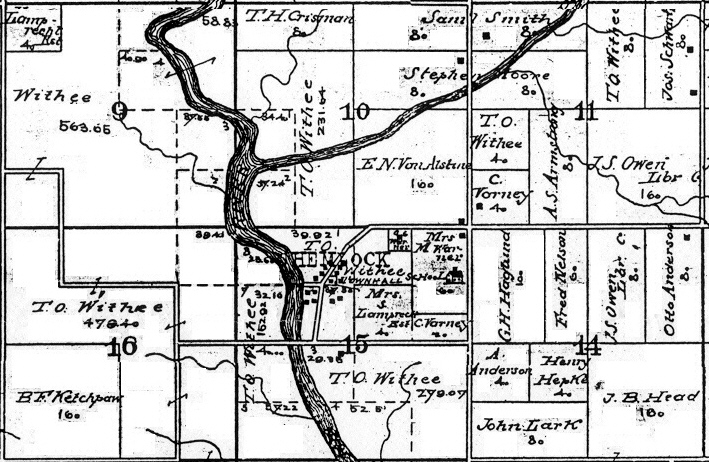
Hemlock, located twenty miles north of Neillsville, in Warner Township, and is the location of the dam of the Black River Logging Company's dam, also of a grist and saw-mill, the latter owned by Niran H. Withee. The dam was completed in 1879, at a cost of $21,000, and is one of the most complete works of improvement in the county. Of the other improvements, the grist-mill was finished in 1879, and is supplied with three run of stone. It is a frame, four stories high, and does a large local business. The saw-mill is also of frame, two stories high, and is furnished with a rotary and upright saw. The total investment is between $10,000 and $15,000. The settlement is connected with Neillsville by telephone, erected in 1879. at a cost of $800.
Longwood Post-office is located eight miles north of Greenwood, and consists of a store and Post-office, kept by Edward A. Eaton. (1881 History of Northern Wisconsin).
Life at Hemlock
Jacob Bibel lived about a mile northwest of Hemlock, on the land later owned by Al Armstrong. Bibel who had come from the old country a few years previous, was a tall, homely, man with large protruding eyes and black whiskers that made him look like a monkey. He had found a wife near Milwaukee, who was seventeen years old when he married her and bore a poor reputation. She was a good worker and always helped with the outside work. One day in January 1881, while the two were hauling logs to Black River at Hemlock and while unloading, they became involved in a dispute. Mrs. Bibel drew a revolver, which she always carried, and shot him dead. She dragged the body back into the woods and left it. She returned home with the ox-team and went about her work as usual. Later she went to Harry Meads, telling them Jacob had gone away with a man and had not returned. About a week after, Joe Palmer, the miller at Hemlock, and Fred Limprecht noticed crows or ravens circling and cawing around and knew something was wrong, so went to investigate and found the body of Bibel doubled up behind a log, frozen stiff. The body was brought to town and put in Honeywell's warehouse, the building later occupied by Ed Schwarze. As some men were putting the body into a barrel of water to thaw it out, Woodie Chandler, who happened to be "about three sheets in the wind", said "Take another dive, Jacob, take another dive". For a long time after this building was a place to fear, and even adults hurried past after nightfall.
Mrs. Bibel was arrested and taken to Neillsville and while there in jail a baby boy was born to her.
She denied having murdered her husband. When court sat in March, her lawyer, Robert J. McBride, cleared her. She confessed, but claimed self-defense, as Jacob had come toward her threateningly with a canthook.
1890
There are a large number of small streams, without names, flowing through Warner township—enough to water the surface sufficiently. Black river flows south through the eastern township. Popple river unites with Black river in this town, just above the village of Hemlock. A large flood dam has been built across Black river at Hemlock, which is used in flooding or floating logs down the river, and also in running the mills at Hemlock. The South Fork of the Eau Claire river flows through the middle township, and the North Fork of the same river through the western township. All of these streams have been used largely in floating the pine timber, which grew in the town, to market. The western township was originally covered with a thick growth of pine timber. This however, has nearly all been cut, leaving but very little timber of any value.
The little village of Hemlock, on Black river, has two large mills, one flour mill and one lumber, shingle and lath mill. The water power, by which these mills are run, is unlimited here. There is a sufficient volume and fall to run any number of mills and factories. Hemlock is the northern terminus of the telephone line which extends south to La Crosse, and east to the towns on the Wisconsin Central line. It is the longest telephone line in this section of the country.
The census reports for '75, '80 and '85 recorded the population of Warner Township, which included Hemlock were: in 1875, 294; in 1880, 435; in 1885, 590.
At one time the Warner Town Hall was situated in the tiny village of Hemlock. The officers of Warner township for 1890 were: Chairman, W. H. Mead; clerk, William Vollrath; treasurer, Henry Humke; assessor, A. Larson.
(Source: Clark Co. Illustrated, 1890)
The Hemlock, WI Community Scrapbook
|
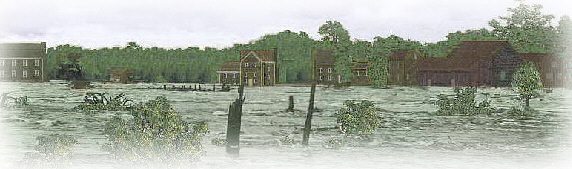
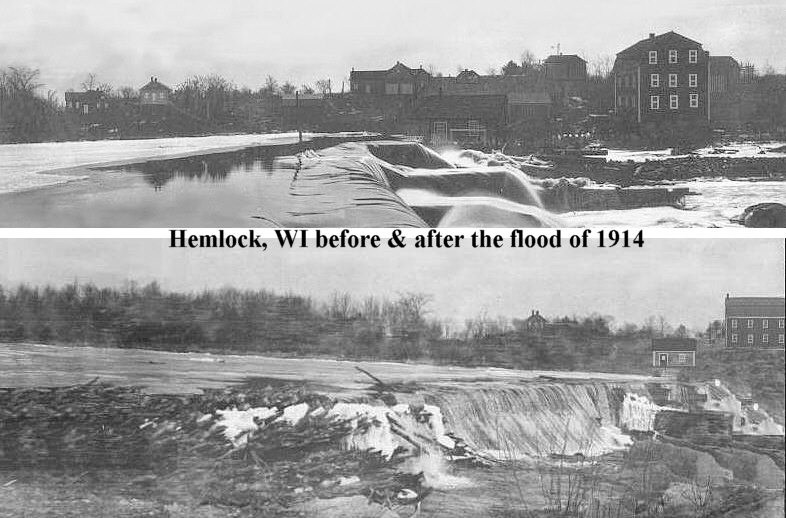
The Flood of Hemlock-1914 The saw mill was taken first and when it swung down stream the roller mills were hit and tipped off its foundation. The bridge was first to go, followed by other small buildings and some lumber and shingles. Men and teams were at work there most of the afternoon taking the grain, flour and feed out of the mill to a place of safety. But before their task was completed the mill was taken by the torrent of water. During the afternoon crowds of sight-seers were at the dams and bridges watching with a great deal of excitement as debris, roots, logs and other material came floating down stream. At one time great fear was entertained for the safety of the wagon bridge when the roof of the Hemlock mills was seen coming down stream. The bridge received a severe jolt and the roof collapsed and slid under. (Greenwood Gleaner, June 14, 1914).
The History of Clark County, Wisconsin, compiled by Franklin Curtiss-Wedge in 1918 says the three greatest disaster to befall Greenwood were the fire of 1885, which destroyed eight buildings and left a blackened gap in the village, the fire of 1900, which destroyed the Kippenhan & Palms Heading Mill, and the flood of 1914, which took out the dike dam and mill at Hemlock, and the bridge across the Black River, in addition to other damage done in the region up and down the valley. "It is estimated that about 25 feet of the levee on the east bank of the Greenwood Dam was taken out and some damage done to the power house. The ripraping on the east bank was removed and part of the pier in the pond was lifted and taken down stream. The Machinery in the power house, including the switch board and dynamo, were saved by the diligent work of several during the time water was running on the levee...At Hemlock the saw and grist mills were wiped out by the dam bursting." (Greenwood Gleaner, June 11, 1914).
|
*** This copyrighted Clark Co., Wis. genealogy and history material is used on this nonprofit site with permission and may not be copied and posted on any commercial genealogy sites such as Family Tree Maker or the merged companies Ancestry/RootsWeb/MyFamily.
This is a Clark County, WI Internet Library Project
Every submission is protected by the Digital Millennium Copyright Act of 1998.